The Cup That Refused to Become Content
Acronyms:
AC — Air conditioner, the household machine that cools the room, increases the electricity bill, and occasionally sounds like a bronchial animal.
CCTV — Closed-circuit television, a camera system used for surveillance, here used as a metaphor for the mind replaying old humiliations.
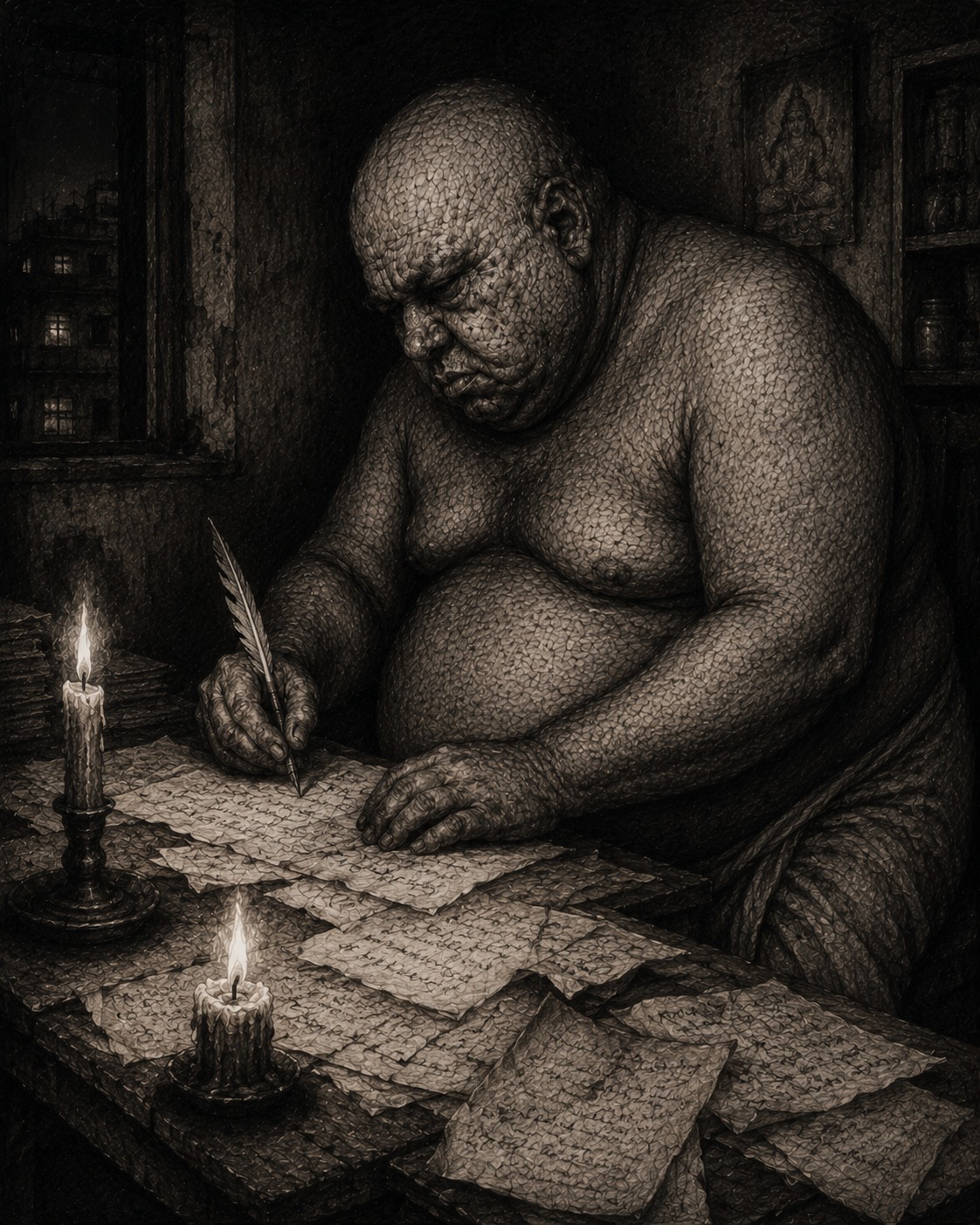
The tea had grown a roof.
Not a respectable roof, like the ones rich people discuss with architects while pointing at sunlight. This was a thin brown skin, wrinkled and slightly oily, floating on top of the cup like a small failed republic. I had left it there too long. That was the whole case against me, really. Leave anything too long in one place and it begins to form evidence.
Tea does it in twenty minutes.
A life takes longer, but not as long as advertised.
I was staring at that cup with the deep philosophical expression of a man who has avoided bathing, employment, and several messages beginning with “Just checking in.” The skin had gathered near the rim and folded itself into a miserable little continent. If I touched it with the spoon, it would tear. Not dramatically. No thunder. No violin. Just a soft little collapse.
That is how dignity behaves too, I have noticed.
Especially after someone asks, with the innocent cruelty of a Bengali relative at a wedding, “So what are you doing these days?”
What am I doing these days?
I am negotiating with disappointment.
No, that sounds too elegant. Negotiation suggests both parties are seated, clothed, and using indoor voices. My disappointment is not like that. My disappointment has entered my room wearing a faded lungi, taken the good side of the bed, eaten the Marie biscuits without closing the tin, and now looks at me as if I am the guest.
So I do what small men do with large problems.
I make notes.
Sometimes I turn the thing into fiction. Sometimes I push it into a paragraph and pretend the man speaking is not entirely me. Sometimes he is a cousin of me. Sometimes he is me after being pressure-cooked with shame, cardamom, and unpaid electricity bills. This helps. Not enough, but enough to keep the day from becoming a blank wall.
Plain speech is impossible for certain kinds of pain. Plain speech is for school applications, bank forms, and the message from the landlord that begins with “Kindly.” Pain does not arrive kindly. It arrives like a ceiling fan with one loose screw, wobbling above your head at midnight, moving the air just enough to prove that movement and relief are not the same thing.
This is where some clean-faced fellow on a podcast will enter the story, because modern life cannot let a wound sit quietly. It must ask for branding advice.
Why not make videos?
Why not build a personal brand?
Why not look into the camera and say, “Hello friends, today I will explain poverty, bipolar depression, loneliness, failed ambition, and the strange aftertaste of middle age in under four minutes”?
Because I cannot.
The thoughts do not come out like toothpaste.
They come out like kidney stones wearing school shoes.
They need previous attempts. Bad openings. Abandoned drafts. Notes typed at 2:17 in the morning when the AC coughs awake outside and the lane goes silent for three seconds, which in Calcutta feels less like peace and more like a clerical error. I sit up with a dry mouth, a full bladder, and a brain replaying old conversations with the dedication of a television channel that has lost all fresh programming.
A camera wants arrival.
A page permits delay.
That is the difference.
A camera wants the visible man. Face. Lighting. Voice. Posture. Background. That little manufactured sincerity people now keep in their eyes, like glucose biscuits for visitors. The page is less demanding. The page will wait while you scratch your head, drink cold tea, change one word, remove three lies, put one lie back because it has rhythm, and then finally admit the thing you had been walking around for two days.
The face cannot do that.
The face is immediate evidence.
My face has become a government building after monsoon: swollen in places, cracked in others, still technically open to the public but not confidently so. If I put it on video, some viewers will diagnose me, some will pity me, some will search for usefulness, and a few will wonder if loneliness has made me romantically available, which is accurate only in the sense that a capsized fishing boat is available to the sea.
No.
I prefer the page.
Also, I have no desire to become shelf stock.
Everything now is packaged. Grief is packaged. Talent is packaged. Anger is packaged. Dissent is packaged. Even authenticity has been washed, ironed, lit from three sides, and sold back to us by people who say “raw” under a ring light. A man cries and a thumbnail appears. A woman says she is healing and a course arrives. Someone discovers vulnerability, and by Thursday it has a payment link.
This is not harmless.
It teaches the poor and the broken that suffering is useful only when it can be made presentable. Trim the edges. Add a caption. Smile at the end. Make the pain digestible for strangers scrolling between a cooking reel, a political shouting match, and a man in Dubai reviewing a gold-plated dessert that looks like diabetes wearing jewelry.
My story is not a product.
It is more like a leaking pipe behind a wall.
You hear it at night.
You cannot afford the plumber.
That is closer.
I am not pretending purity. I have biases, vanities, resentments, and a memory so overactive the municipality should demolish two floors of it. I have the bitterness of a once-promising Bengali boy who did well in exams, crossed oceans, worked in serious rooms, returned, and discovered that knowledge here is often treated like a skin disease unless it arrives in a big car. I have envy. I have anger. I have foolish desires still knocking on doors they should know are closed. I have bills, bad teeth, medical anxiety, rent panic, and that special Indian background noise of someone drilling concrete for reasons no citizen has ever been allowed to understand.
But even then, a voice is a voice.
Not a grand voice.
Not a conch shell.
More like an old radio in a tea stall, full of static, catching one useful line between cricket commentary and a detergent advertisement. Still, that counts. A cracked instrument can still make a note. A cheap pen can still sign a serious document. A man does not have to be polished to be real.
Maybe that is what writing gives me.
Not rescue.
Rescue is a big word, and big words often arrive wearing borrowed shoes. Writing gives me something smaller and more useful. It gives the wound an address. It says: the trouble lives here, third floor, no lift, bell not working, knock loudly because the man inside may be asleep, ashamed, or pretending to be absent.
Some days that is enough.
Some days it is not.
Some days the writing is only a bucket under the leak. The ceiling still drips. The city still sweats. The fish seller still shouts. The news still screams of national glory while the drain outside has a smell old enough to qualify as heritage. In the next room, somebody’s pressure pump starts like a factory being born. On the road, a bike horn performs its small patriotic duty. Somewhere a child is being told to study hard, the oldest lottery ticket in Bengal.
I know that ticket.
I bought it in bulk.
Study hard, they said.
So I studied. Then I studied more. Then I went to America. Then I learned systems, data, work, the dignity of competence, the strange American habit of fixing things before they become folklore. Then I came back and found myself in a rented Calcutta room, counting coins of energy before deciding whether to wash a cup.
Life has a sense of humor.
Not a good one.
More like the humor of a clerk who stamps the wrong form and sends you to Counter 7 during lunch.
Still, I write because talking requires infrastructure. A listener must exist. Time must align. Affection must be available. Patience must be in stock. Conversation is a bridge, and mine collapsed years ago into a river of missed calls, old friendships, migration, shame, illness, and that slow distancing which nobody announces because announcement would require courage.
The page does not ask me to be cheerful.
That is a great mercy.
People ask for cheerfulness the way households ask maids to come on time: as if the whole universe has been arranged for their convenience. “Be positive,” they say. “Everyone has problems.” This is meant as wisdom. In practice it is often a wet towel thrown over a fire alarm.
Everyone has problems, yes.
Everyone also has a stomach. That does not make appendicitis a festival.
Precision matters.
Disappointment is not an abstract noun when you live with it long enough. It has furniture. It keeps accounts. It changes the shape of the day. You wake at nine and suddenly it is afternoon. You think of answering a message and your heartbeat begins rehearsing for a small war. You look at the bathroom and it looks back like a border checkpoint. Anxiety searches every pocket of the mind and delays all movement. Poverty is not just the absence of money. It is the narrowing of imagination. It is the way a small expense becomes a weather system.
A broken tooth can colonize a week.
A pending rent can ruin the taste of rice.
A phone notification can sit on the table like a snake.
These things do not need drama. They already have weight.
And yet the small absurdities continue, because Calcutta never allows tragedy to remain pure. A man may be contemplating the ruins of his life while the neighbor argues loudly about coriander. A philosophical depression may be interrupted by the gas cylinder man. The deepest sorrow may have to move aside because the rice is sticking to the bottom of the pan.
This is useful, in a cruel way.
The ordinary keeps dragging the tragic down from the stage.
You may want to collapse into European despair, but the mosquito has other plans.
That is why I distrust grand statements about suffering. They are usually written by people with clean floors. Real suffering is not cinematic. It is logistical. It asks whether there is enough tea. It checks the balance. It wonders if the medicine strip has two tablets or three. It postpones the haircut. It eats leftovers standing up. It forgets to reply. It fears the dentist. It opens the fridge and discovers one onion, half a lime, and the emotional biography of a failed week.
So why write about it?
Because suffering that is only suffered becomes sludge.
Writing does not purify it. I am not in the purification business. Writing gives it shape. A little edge. A cup. A nail on the wall. Something by which it can be held for a moment without spilling all over the floor.
Also, someone else may read one line and feel less alone.
That sentence worries me because it sounds noble, and nobility in middle age is often gas wearing a shawl. But it may still be true. Not in the grand way. In the bad-umbrella way. The umbrella is bent, ugly, unreliable, and embarrassing in public, but when the bus throws drain water into the monsoon, you are grateful for anything between your head and the sky.
There are many people who cannot say these things.
Not because they are stupid. That is the lazy explanation of comfortable people. Many are simply trapped. By family. By work. By marriage. By caste. By gender. By respectability. By religion. By money. By the ancient Indian pressure cooker called “what will people say,” which whistles all day and has never cooked anything edible.
If they could speak freely, maybe some would say: yes, this. This exact stale smell of a life that did not open where it was supposed to open. This comedy mixed with nausea. This humiliation of still being conscious after the advertised future has closed its shutters.
I am not their leader.
That would be alarming. I cannot lead myself to the bathroom some mornings without negotiation.
But maybe I can be a minor clerk in the archive of the obstructed.
A tired, tea-stained clerk. A man filing small evidence after office hours. Panic. Rent. Mother. America. Toothache. Rice. Monsoon. Shame. Lust. Memory. Science. Loneliness. Unpaid invoice. Mosquito. Another mosquito. Always another mosquito.
That is not literature with garlands.
It is paperwork against disappearance.
The cup is still on the table. The tea skin has folded into a brown little map near the rim. I should wash it before it becomes archaeology. I may not. Even laziness now wants documentation, the pompous creature.
Outside, someone is hammering something invisible into something unwilling. Inside, my stomach makes a sound like a dying harmonium. For a moment I feel nearly proud that I have not been fully converted into content.
Then I spill tea on my shorts and continue being evidence.